Liability for Repairs
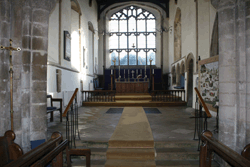 Some parishes have a lay
rector, who has a legal obligation to meet the cost
of repairs to the church chancel. This type of liability has existed since
long before the Reformation. It arose as the result of ownership of glebe
land by the rector of a parish or his entitlement to tithes. In many cases
the ownership of land which formerly belonged to a rectory still carries
with it the burden of repairing the chancel. For a detailed explanation of
the history of the liability for chancel repairs, we can do no better than
refer you, with the consent of the author, to the transcript of an
excellent talk given by Derek Wellman,
former Registrar of the Diocese of Lincoln, to members of the Ecclesiastical Law
Association on 8 April 2000.
Some parishes have a lay
rector, who has a legal obligation to meet the cost
of repairs to the church chancel. This type of liability has existed since
long before the Reformation. It arose as the result of ownership of glebe
land by the rector of a parish or his entitlement to tithes. In many cases
the ownership of land which formerly belonged to a rectory still carries
with it the burden of repairing the chancel. For a detailed explanation of
the history of the liability for chancel repairs, we can do no better than
refer you, with the consent of the author, to the transcript of an
excellent talk given by Derek Wellman,
former Registrar of the Diocese of Lincoln, to members of the Ecclesiastical Law
Association on 8 April 2000.
The House of Lords decision in the case of Aston Cantlow PCC v Wallbank [2003] UKHL 37 and the provisions of the Land Registration Act 2002 and the Land Registration Act 2002 (Transitional Provisions) (No.2) Order 2003 are of importance to Parochial Church Councils ("PCCs") who know of the existence of a lay rector who owns land to which the liability attaches. The linked paper entitled The Consequences of Aston Cantlow, by Edward Nugee QC, which is reproduced from Issue 35 of the Ecclesiastical Law Journal by kind permission of Mr. Nugee and the Ecclesiastical Law Society, gives a very clear explanation of chancel repair liability and the consequences of the Aston Cantlow case and changes under the Land Registration Act.
The 1985 Law Commission Report on Chancel Repairs is available on the British and Irish Legal Information Institute web site. It contains a useful explanation of the origin and history of the Chancel Repair Liability.
Action to be taken by Parochial Church Councils
The Aston Cantlow case affirmed that a PCC can take proceedings to recover the cost of chancel repairs from a lay rector. However, chancel repairs will no longer be regarded as overriding interests (that is to say, binding without the need for registration) under the Land Registration Act 2002, which came into force on 13 October 2003. The Land Registration Act 2002 (Transitional Provisions) (No.2) Order 2003 provided that chancel repair liability would continue to be an overriding interest for a period of just ten years from 13 October 2003. After that period, the liability will only be binding on a purchaser of land registered at the Land Registry if the liability is referred to in the Register.
Therefore, there was a need for PCCs to check before October 2013 whether there was any land liable for chancel repairs in respect of their churches. If there was any liability for chancel repairs then the PCCs should have sought advice from their solicitors about registering at HM Land Registry a caution against first registration of the land (if the land affected by the liability was unregistered) or registering a notice (if the land was already registered), in order to alert a prospective purchaser to the liability. Otherwise the result of not registering will be that the right to recover the cost of chancel repairs will be lost in the event of the transfer of the land after the ten year period to a purchaser without notice of the liability. It is not too late to register the liability, provided that the land in question has not been sold since 13 October 2013. However, for an application after that date a Land Registry fee will be payable.
In October 2012, the Diocesan Registrar issued some Guidance to all clergy and PCCs in the Diocesan of Peterborough regarding the need to register chancel repair liability. This guidance should be read in conjunction with the following:
Church Commissioners - Explanatory Notes to PCCs
Legal Advisory Commission - Opinion
Charity Commission - Guidance
Church of England - Questions and Answers
Church Care - Questions and Answers
National Archives - Guidance
Land Registry - Practice Guide 66
Researching Chancel Repair Liability
No diocese will have a definitive register of lay rectors responsible for chancel repairs. When in the past land carrying the liability has changed hands, there has not been any obligation (and it has naturally not been in the interests of the acquiring party) to inform anybody that they are now liable for repairs to the chancel. However, the liability for chancel repairs has always been what lawyers call "an overriding interest", which means that it has not been necessary to protect such a right or interest by registration.
From time to time, Diocesan Registrars receive enquiries from solicitors acting for purchasers of property as to whether any particular property carries with it a liability for chancel repairs. For the reason already given, that there is no definitive diocesan register, it is unlikely that a Registrar can, without a good deal of research, give a categoric answer one way or the other as to whether there is any person or body liable to meet the cost of repair of the chancel of a church, unless the Registrar happens to have documentary evidence in the Registry that the liability exists in a particular case.
In the Peterborough Diocese, in 1977, and again in 2002, the Registrar asked the Archdeacons to include in their annual Articles of Enquiry to the Churchwardens, some questions regarding chancel repair liability. Churchwardens were asked if they knew of the existence of a lay rector and, if so, when was the last time that the lay rector was asked to contribute to the cost of repairs to the chancel. The Registrar is prepared to respond to written enquiries from solicitors and prospective purchasers as to whether the returns refer to any particular parish. But the Registrar cannot give any guarantee as to the accuracy of the information provided. The absence of any relevant information does not guarantee that no liability exists. Nor does the inclusion of an alleged lay rector guarantee that such lay rector ever was or remains liable. The results simply reflect the knowledge or belief of the Churchwardens at the time. A solicitor or the purchaser of a property, who is concerned as to whether any liability exists and affects a particular property, should have a search carried out by a company specialising in chancel repair liability searches. The Registrar can provide the names of companies which do such work.
For those wishing to research chancel repair liability, there is a very helpful book by James Derriman, entitled Chancel Repair Liability - How to research it (Revised Edition) ISBN 9781898029847. Published by Wildy, Simmonds & Hill, Lincoln's Inn Archway, Carey Street, London WC2A 2JD. Price £24.95.
For those interested in the history of tithes and tithe records, there is a very helpful article at the National Archives web site.
For conveyancers, there is an interesting article in the Law Society Gazette of 5 May 2014.
There is also some very useful information at the following web site:
http://www.stmichaelspenkridge.co.uk/chancel.html
Church Commissioners' Chancel Repair Liabilities
PCCs are advised to read the attached letter and FAQs from the Church Commissioners' Pastoral and Closed Churches Department issued in February 2015.